Table of Contents
- Best and worst options for SaaS pricing consultants
- Why Are Founders Suddenly Hiring SaaS Pricing Consultants?
- What A Great Pricing Consultant Actually Delivers?
- SaaS Pricing Advice Can Cost You More Than You’d Save
- Here’s What You Want In A Pricing Consultant…
- The Goldmine You're Already Sitting On
- What A SaaS Pricing Consultant Costs'
- These Are The Questions You Need To Ask…
- FAQ
- I Want You To Have Better Data & Better Outcomes
Best and worst options for SaaS pricing consultants
I was recently talking to my team about the sheer number of SaaS founders who come to us convinced they have a churn problem, when really they have a pricing problem.
The product is fine. The market wants it.
But the pricing model is letting the wrong customers through the front door, and no cancellation flow in the world fixes that upstream.
Pricing is the highest-leverage decision you'll make in your SaaS business, and most founders treat it like an afterthought.
They pick a number that "feels right," launch, and then spend the next 18 months wondering why revenue won't budge!
The ones who get it right usually had help. Finding that help is its own challenge.
The market for SaaS pricing consultants runs from excellent operators all the way down to people who are very good at sounding authoritative and not much else.
So for this guide I brought in someone who sits on the other side of the table: Serge Herkül, founder of the SaaS pricing consultancy Potio and former CEO of Toggl.
Serge has made pricing decisions with real money on the line and now advises SaaS and AI companies on them. He knows what a good engagement looks like from both seats.
Here's what actually works, what doesn't, and what to ask before you hand anyone a cheque.
Why Are Founders Suddenly Hiring SaaS Pricing Consultants?
Your pricing tells potential customers who your product is for, what kind of commitment you expect, and whether you understand their business.
Get it wrong and you'll attract customers who…
- Churn fast
- Undervalue your product
- Never convert from a free trial
You're balancing acquisition costs against lifetime value, thinking about plan tiers, deciding whether to charge per seat or per usage, figuring out where to put your freemium wall if you have one... and all of this while trying to run a company. It's a lot!
Among the top 500 SaaS and AI companies with transparent pricing, there were more than 1,800 pricing changes in 2025 alone, averaging about 3.6 changes per company (PricingSaaS Trends Report, Q2 2026).
That covers price updates, packaging changes, feature tiers, and credits models, which surged 126% year over year.
Pricing stopped being static.
Serge thinks most founders underestimate the job because they picture the wrong thing.
"People picture pricing as choosing the right number on the pricing page," he told me. "That's the tip of the iceberg."
Underneath sit six layers that all have to make sense first:
- Capability. what you actually sell
- Fencing. who you sell it to, and who you don't
- Packaging. how you bundle your features and services
- Pricing model. how you charge, and on what value metric
- Monetization mechanics. discounts, trial terms, contract length, etc
- Price points. The actual $ amount. Last on the list for a reason.
The dollar amount comes last.
"If your packaging is broken, no price point saves you," Serge says. "Updating a number takes an afternoon. Rebuilding your pricing structure is a cross-functional project that touches every department."
A good SaaS pricing consultant can change the trajectory of a business. The trick is knowing which one you're talking to.
What A Great Pricing Consultant Actually Delivers
The deliverable is a pricing architecture you can implement, not a deck that collects dust.
In practice it breaks into three things.
Structure Comes First
Your tiers, add-ons, and value metrics. Which features go in which plan.
What separates your $50 customer from your $500 customer.
Whether your tiers should be built by job, by persona, or good-better-best.
Done well, this doesn't only capture more revenue. It makes selling easier, because reps know exactly what to pitch to whom and customers self-select into the right tier.
Then The Model And The Math
A strong consultant works both directions:
- Top-down - what price levels and conversion rates hit your revenue target
- Bottom-up - what usage and adoption patterns project forward from real customer behaviour
If you're shipping AI features, this is where unit economics get real.
Traditional SaaS runs at 80%+ gross margins, so sloppy discounting rarely kills you. AI flips that.
Margins on AI features can swing from deeply negative to strongly positive across your customer base depending on usage and model costs.
A good consultant builds guardrails before your sales team starts handing expensive features out at a flat rate.
Rollout, The Part Most Consultants Skip
This is where strategy-only engagements die.
Real rollout work looks like:
- Blueprints for your billing engine and CRM
- Sales enablement and objection handling
- A migration plan for legacy customers that doesn't trigger a churn spike
Forrester attributes a large share of failed pricing initiatives to inadequate systems support. The model was right. It just never made it into the billing system or the sales playbook.
If the engagement ends with a slide deck and a handshake, the strategy is dead on arrival.
SaaS Pricing Advice Can Cost You More Than You’d Save
Let me start here, because I see these mistakes constantly with SaaS operators who come to us after a bad experience.
Solutions Before Diagnosis
The most reliable red flag is a consultant who prescribes a pricing model in the first conversation.
Before they've looked at your sales data. Before they've seen your segments or your expansion metrics.
They aren't solving your problem. They're applying the last client's answer to your business.
A good consultant has a base framework, but the work morphs to fit the company. If they show up with answers before they've talked to you or seen your numbers, walk away.
Slide Deck Merchants
These are smart, credentialed people who have done good work in consulting generally, but SaaS pricing has nuances that don't translate from traditional business models.
Recurring revenue, expansion MRR, net dollar retention... these describe a fundamentally different relationship between a business and its customers.
A consultant who doesn't live in these metrics daily will hand you generic frameworks that sort of apply and miss the specifics of your situation.
The deliverable is usually a polished deck with a pricing matrix and some competitor benchmarks.
What it won't tell you is…
- How your pricing affects trial-to-paid conversion
- Where customers are churning over frustrations they never shared
- How a small change to your annual discount structure could improve cash flow
The tell is when the deck is the engagement, rather than a reference doc that fell out of real working sessions.
One-Worksheet Wonders
There are people selling pricing courses and templates disguised as consulting engagements.
They'll walk you through their "methodology" and "worksheets" step by step.
The output looks thorough and often feels validating, because it confirms a lot of what you already suspected.
The issue is that frameworks are built for the median case and your business isn't the median case!
I've always found that the consultants most attached to their own worksheets are the ones least interested in understanding yours.
One-Hit Wonders
Someone helped a company raise prices by 40% and it worked. Now they're a pricing consultant!
X is flooded with these people…
I'm not questioning whether the experience was real.
The problem is that one success doesn't mean they understand why it worked, or how to repeat it in a different context.
They'll run the same play regardless of fit, because it's the only play they have.
Here’s What You Want In A Pricing Consultant…
Past the credentials and case studies, a handful of traits separate the people worth hiring.
People Who Live Inside The Numbers
The best pricing consultants for SaaS companies spend most of their time inside SaaS businesses.
They know the difference between usage-based and seat-based pricing, not just in theory, but from watching each model play out across different customer segments and sales motions.
The Scar Tissue Crowd
There's a growing group of fractional executives and advisors who were revenue leads or heads of growth at SaaS companies and now work with several businesses at once.
Their advice tends to be more practical, because they've made pricing decisions with real consequences instead of observing them from the outside.
The question to ask is whether they've personally owned a pricing change.
Consulting on one is fine. Being accountable for what happens the morning it goes live is a different job.
Someone Your Executives Will Take Seriously
Pricing touches product, sales, marketing, finance and engineering.
Bain's data shows active C-suite sponsorship makes pricing initiatives 3.5x more likely to succeed.
A junior analyst can't earn that sponsorship. Someone who has sat in the seat can.
People Who Understand SaaS And AI Economics
Subscription mechanics matter: net dollar retention, churn, expansion revenue, LTV/CAC, and the constraints of your billing stack.
For AI companies the bar is higher. Every query burns compute, and a power user can consume 100x more than a casual one on the same flat plan.
A consultant who treats that as a footnote will get your margins wrong.
Serge comes at this from an engineering background and digs into cost-to-serve data before touching packaging. His logic is that a credit system has to map to actual compute, not just look tidy on the pricing page.
Big Firm Or Boutique?
The shape of the market matters here.
Large firms like Simon-Kucher bring pattern recognition from thousands of engagements. They're a fit above roughly $50M ARR, where the complexity justifies the cost.
Below that, the sweet spot is usually a specialist independent or a boutique, the tier where Potio and firms like it operate.
You get senior operators who live in subscription metrics and focus on work you can ship rather than frameworks you can admire.
The Goldmine You're Already Sitting On
This is the most underused pricing resource most SaaS companies have: your own cancellation flow.
When customers leave, they often tell you exactly what went wrong, pricing included.
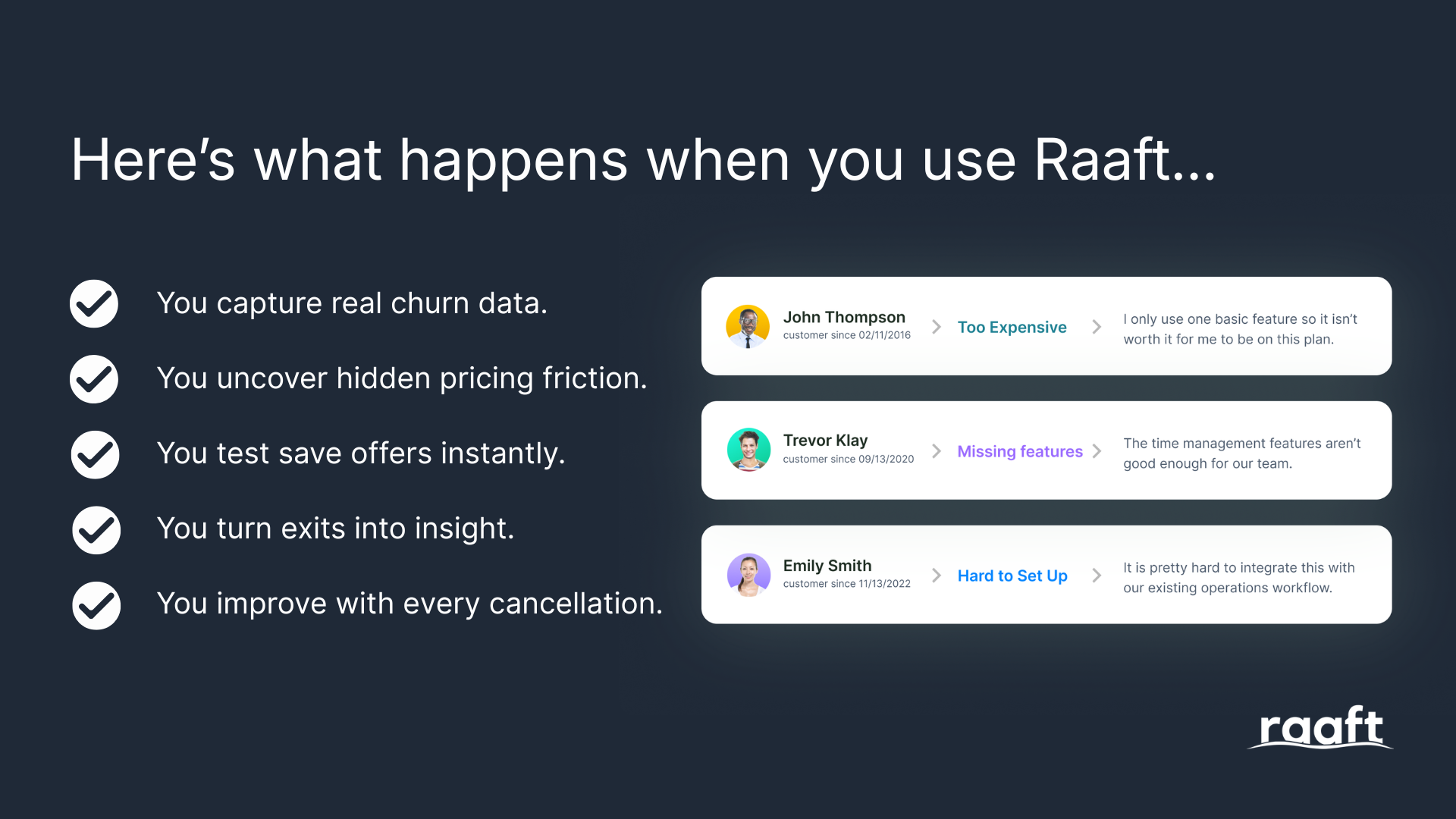
"Too expensive" is easy to dismiss as a negotiating line.
But when it shows up next to "switched to a competitor" and "not enough features for the price," patterns emerge that should feed straight into your pricing decisions.
We see this data across a lot of SaaS businesses at Raaft, and the friction rarely looks the way founders expect.
Customers who pick "too expensive" are often on your highest tier but never got the value that justified it.
That's an onboarding and adoption problem wearing a pricing costume.
The point isn't the tool. It's that even the best pricing consultant is limited by the quality of your data.
If you can't say why users churn, what plans they were on, and how they responded to a save offer, you're asking your consultant to work blind.
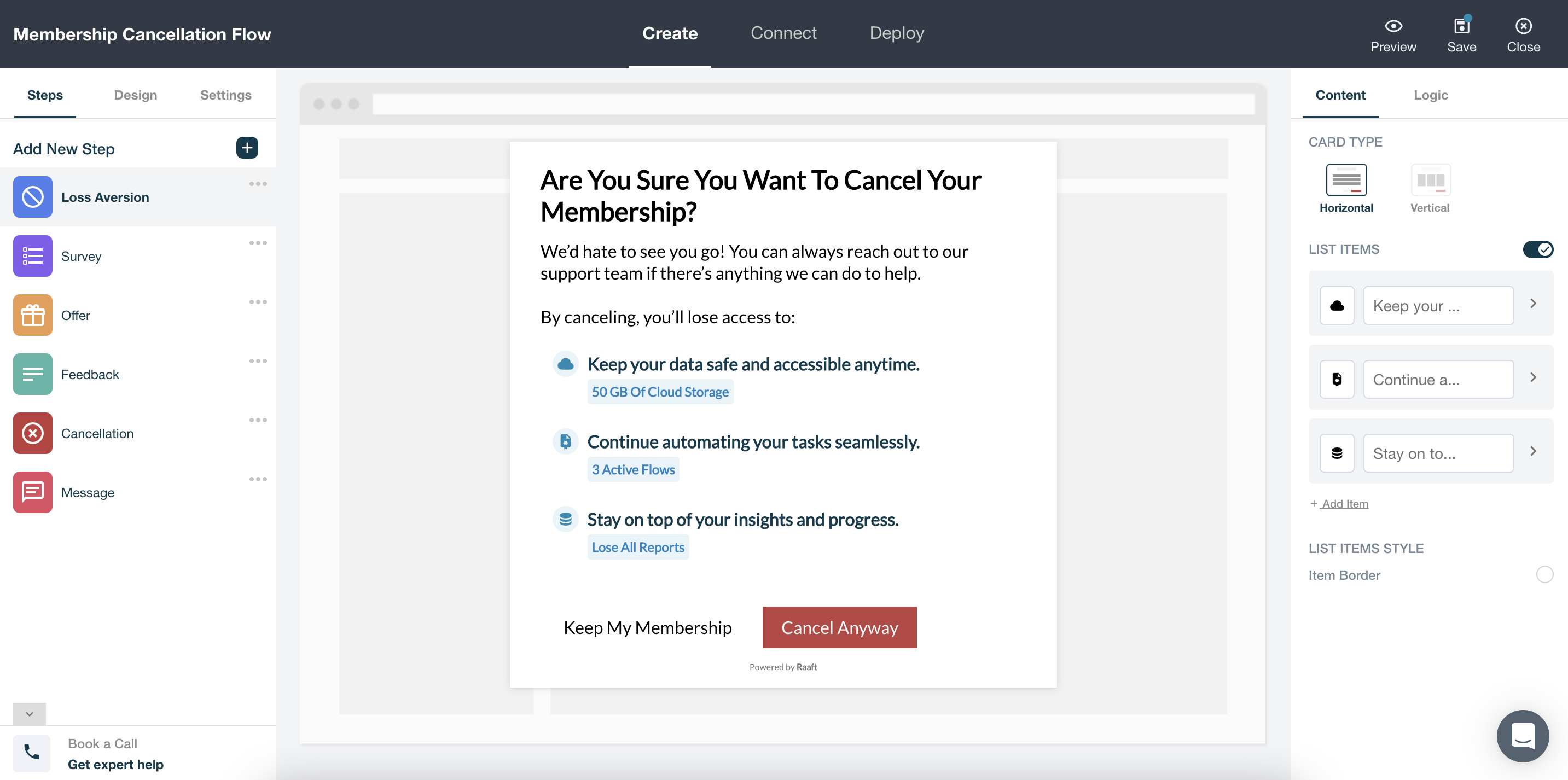
Walk into an engagement with evidence instead of assumptions and the whole project gets sharper.
What A SaaS Pricing Consultant Costs
Fees track the type of firm and the scope, and the tiers are fairly distinct.
| Type | Typical fee | Best fit |
|---|---|---|
| Independent specialist / fractional exec | $25K - $150K | Up to ~$50M ARR |
| Boutique pricing firm | $100K - $500K | $50M+ ARR, parallel workstreams |
| MBB / Big 4 | $200K - $1M+ | $100M+ ARR, pre-IPO, large transformations |
A few things worth knowing about each tier.
Independents and fractional execs are often ex-operators, which is why they punch above their fee at smaller ARR.
Boutiques can run parallel workstreams across a larger org, though the actual work sometimes gets delegated to junior staff. Ask who will be on your project.
MBB and Big 4 are built for scale. If you're a 25-person company, you're not their target client and the recommendations will reflect that.
One useful gut check: a 10% improvement in average revenue per user compounds aggressively over time. The fee is rarely the thing that should stop you. A bad fit is.
These Are The Questions You Need To Ask…
A few things worth testing before you sign anything.
"Why did your last client's pricing change work?" Not that it worked. Vague answers about value alignment are a red flag. Good consultants trace specific changes to specific outcomes.
"What do you need to see before making a recommendation?" If they want your CAC and expansion metrics first, they're thinking about the right things. If they lead with competitor pricing, they'll anchor you to the market instead of your actual value.
"Have you ever recommended against a price increase?" The best advice isn't always charge more. Sometimes it's a restructuring, and a consultant with only one direction of travel will miss it.
"Can I speak to a past client?" Not a polished case study. An honest conversation about how hands-on they were, whether the recommendations survived contact with reality, and whether they'd hire them again. If nobody will vouch for the work, that tells you something.
FAQ
What does a SaaS pricing consultant do? They help you design and ship a pricing architecture: tiers, packaging, value metric, discounting rules, and the rollout into your billing system and sales playbook. The strongest ones model the revenue and margin impact and stay involved through implementation.
How much does a SaaS pricing consultant cost? Independent specialists and boutiques usually run $25K to $150K per engagement. Larger firms charge $100K to $500K+. MBB or Big 4 engagements run $200K to $1M+. Below $50M ARR, a specialist independent is almost always the better economics.
When should I hire one? Common triggers are a growth ceiling you can't price your way past, a shift to usage-based or hybrid pricing, launching a multi-product platform, monetizing AI features, or integrating pricing after an acquisition. If pricing keeps coming up in board meetings, you've probably waited too long already.
Should I hire a consultant or build pricing in-house? Below roughly $50M ARR, most companies get better ROI from an external specialist than a full-time hire. Above that, an internal pricing function makes the economics work.
Do I need a consultant if I'm early-stage? Not always, but it can help. If your pricing question is simple and your data is thin, fix your measurement first, starting with why customers actually churn. Early-stage is also where good pricing advice has the highest leverage, because a small structural fix compounds for years.
I Want You To Have Better Data & Better Outcomes
The biggest risk in hiring a SaaS pricing consultant is paying for a generic slide deck with no implementation plan.
The right one adapts to your business, has the seniority to align your executive team, understands SaaS and AI economics, and builds something you can actually ship.
They act like a temporary member of your team, not a vendor delivering conclusions from the outside.
Whoever you hire, give them real data to work with.
Capturing why customers leave, what they were paying, and how they respond to save offers turns a pricing engagement from guesswork into evidence.
That's what a structured cancellation flow is for, and it's the cheapest upgrade you can make to any consultant's work.
Thanks to Serge Herkül for the input on this one. If you want to talk pricing with him directly, he's at Potio.
You can try Raaft for free or book a demo to see how it fits.
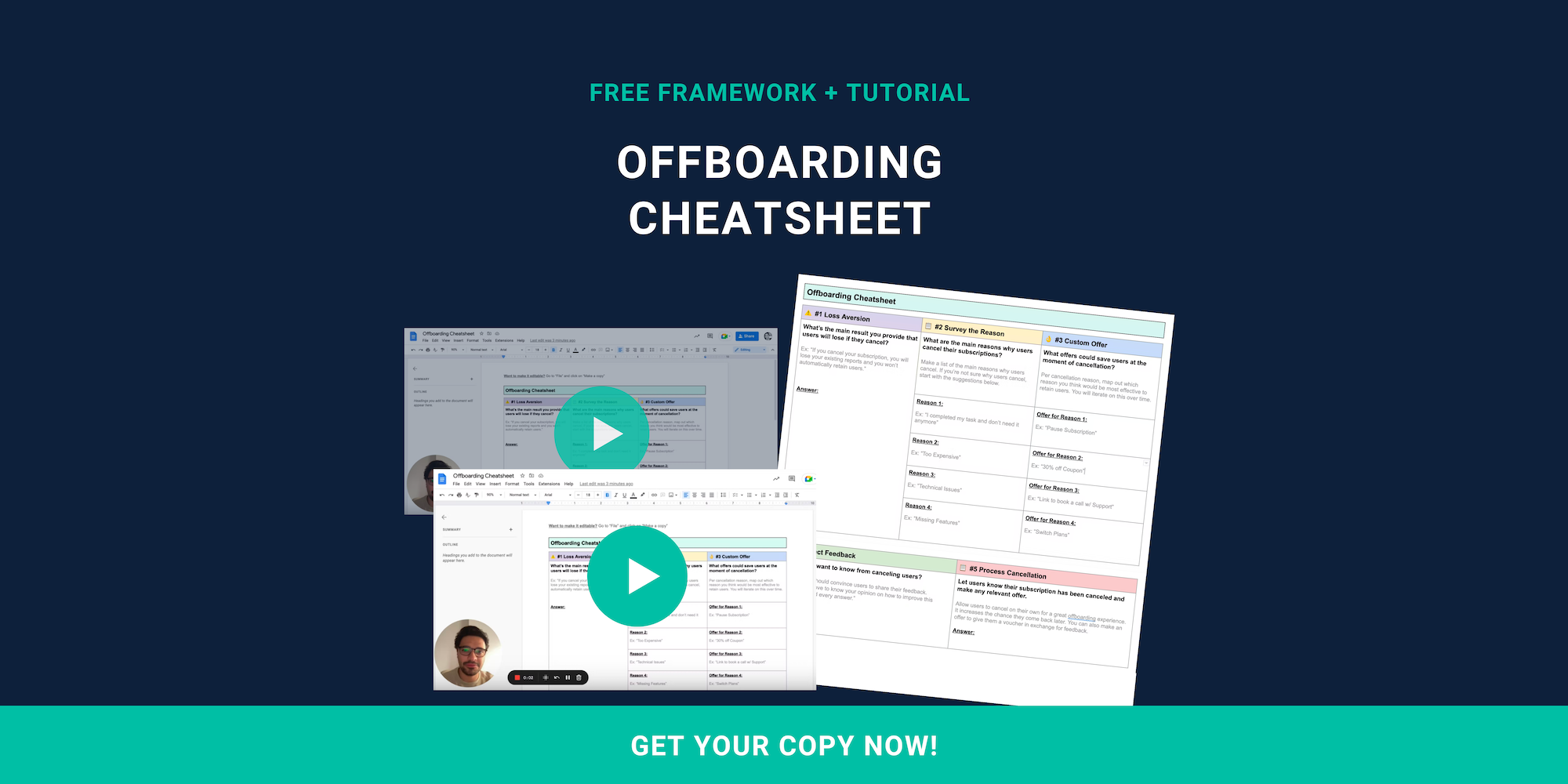
Offboarding Cheatsheet
This framework + video tutorial will help you design a better cancellation process.
Some of our featured articles


Miguel Marques

Miguel Marques
![5 Best Product Survey Tools: Here’s What I’ve Found [2025 Research]](https://raaft-website.s3.amazonaws.com/img/blog/thumbnails/Best-Product-Survey-Tools.png)
Miguel Marques
Customer Success insights in your inbox
Helping Founders and Customer Success Managers handle customer retention effectively.
We will only ever send you relevant content. Unsubscribe anytime.